Sunday, June 10, 2012

Me with Lowry


Bronze statue of Stretford born artist L.S.Lowry at the junction of Hyde Road and Stalybridge Road, Mottram.


Six months ago I took up art - seriously.  I have been on several courses, bought a lot of self-tuition books, a small fortune’s worth of paint, paper, pencils, pens, brushes and a plethora of other arty goods.  Occasionally I have even practised my latest obsession.

While wandering the uninspiring streets of Mottram near Manchester recently, looking for inspiration, I stumbled upon a fellow sitting sketching on a bench.  Keen to air my new knowledge I settled beside him and made what I believed to be some constructive criticisms of his drawing.  I was rather miffed that he gave me no thanks; furthermore he seemed mildly irritated by my suggestions.

"The Elms" on Stalybridge Road.  Lowry’s home from 1948 until his death (1976).


Friday, May 25, 2012

Last Irish chase of the season

Today my search for places with cultural connections in Ireland led me to ‘The Laurels’ a comparatively recently abandoned house located a short distance to the far side of Glenties from the cottage in which I have been staying this week.  ‘The Laurels’ was the home of playwright Brian Friel’s maternal grandparents where, with his  two sisters, the young Brian spent most of his childhood summer holidays.  As recently as 1998 when, I understand, it was used as one of several locations in the area for the shooting of Pat O'Connor’s excellent film of Friel’s play, “Dancing at Lughnasa”, the house must have been in a better condition than that in which I found it today.  Indeed, although it is but a stone’s throw beyond the village, lost in its overgrown garden the house was far from easy to find.  ‘Ballybeg’, the fictional village in which several of Friel’s plays are set, is based on Glenties.
I also visited Glenties museum, a wonderfully eclectic gathering on three floors, of artifacts, photographs and newspaper clippings telling stories of life and events in and around Glenties through, largely, the past couple of hundred years.  I particularly enjoyed discovering, in a display of genuine items arranged to feign an early twentieth century kitchen, three of the silk stockings Meryl Streep had worn while filming “Dancing at Lughnasa”, hanging from a line above the kitchen range.  The logic of why there should be three stockings rather than a pair or any number of pairs caused me more than a little head scratching!

Wednesday, May 23, 2012

A fishy tale, the hero of which is a frenchman!


The cottage I have rented here in Donegal is semi- detached to another.  I suspect that originally the building may have been a byre.  Until yesterday morning I had neither seen nor heard my neighbours but knew I had some and believed them to be french because I had seen a french registered car parked beside my own.  Yesterday morning, as I was getting into my car to go out for the day, my neighbours, an early middle-aged couple, were also leaving their cottage.  In my best french I bade them ‘Bonjour!’ which must have led them to believe I had a fluency of their language.  Confronted with french people speaking french, such facility of speaking it as I pretend to have abandons me.  They neither speak, nor make any pretence of being able to speak, english.  Nonetheless we managed to communicate enough for me to learn that they have been coming to this same cottage each year for several years for him to fish; he is a keen fly fisherman.  Nothing was said about how madame spends her day while monsieur is spending his, rod and line in hand, up to his waist in river water.

Yesterday evening there was a tap on my door.  I opened it to monsieur who held in his hand a sheet of tin foil on which lay three glistening very fresh trout, gutted and ready to cook.  ‘Pour vous’, I think he said.  I thanked him in my best italian then, realising my mistake, in my best greek.  Fortunately Lisi and Linda, who were in the cottage with me, were able to step in and take over thanking monsieur for his kindness.

The trout were eaten this evening and were as tasty as I had anticipated they might be.  Shortly after eating them I again answered a rather nervous tap at the door.  Monsieur stood before me, as incapable of utterance as I, offering me six further beautiful fresh trout.  ‘Thank you’, I said, ‘Thank you so much!’.  He seemed to understand.

Oh!  How I am coming to love the french!

Mount Vernon


Strolling along the track beside the ‘Flaggy Shore’ at the edge of the Burren I noticed amongst the  usual gathering of utilitarian sea-side villas an older, more interesting building.  Hoping to learn more about it I took a few snapshots.  My casual interest has been well rewarded.

Mount Vernon was built in 1788 for Colonel William Persse, a friend of John Wesley and George Washington who is reputed to have sent seed or plants for the fine trees yet living in the garden.  Persse named his new house after Washington’s Virginia home.

Later the house was owned by Sir Hugh Lane who, in 1908, established Dublin’s first public gallery of modern art.  When Sir Hugh, a passenger on the ill-fated Lusitania (Torpedoed by a german submarine in May 1915.),  drowned the house passed to his aunt, Lady Augusta Gregory a leading light of Ireland’s cultural renaissance and confidante of George Russell (AE), J. M. Synge, G. B. Shaw and W. B. Yeats.  Lady Augusta gave the house to her artist son, Robert, who was killed while serving with the RFC in France.  Yeats’ poem “An Irish Airman Foresees his Death” has immortalised the event.

        An Irish Airman Foresees His Death

        I know that I shall meet my fate
        Somewhere among the clouds above;
        Those that I fight I do not hate,
        Those that I guard I do not love;
        My country is Kiltartan Cross,
        My countrymen Kiltartan's poor,
        No likely end could bring them loss
        Or leave them happier than before.
        Nor law, nor duty bade me fight,
        Nor public men, nor cheering crowds,
        A lonely impulse of delight
        Drove to this tumult in the clouds;
        I balanced all, brought all to mind,
        The years to come seemed waste of breath,
        A waste of breath the years behind
        In balance with this life, this death.

The house is now run as a country house style B&B which I have investigated through trip advisor.  From what I have read there particularly the negative comments which say rather more about the disgruntled guests than they do about Mount Vernon, I believe I might enjoy a few days stay at there when I next visit Ireland.


Glenties

Somewhere in the distance is the small town of Glenties, home village of author and dramatist Brian Friel considered, by many who are qualified to judge these things, to be the greatest of living playwrights writing in English.  Glenties has been identified as the model for Friel’s frequently employed fictional, Ballybeg (from the Irish, Baile Beag, which translates into English as "Little Town").  The environs of Glenties were also used to great advantage as a location by Pat O’Connor when he made his beautiful 1998 film based on Friel’s play, “Dancing at Lughnasa”, which starred Meryl Streep and Michael Gambon.

Also in the distance, a couple of kilometers nearer than Glenties, is the cottage I have rented for this week.

Tuesday, May 22, 2012

Somewhere in the far distance is America


Standing high on these cliffs looking down on the calm sea on a benign spring afternoon it is difficult to imagine what might have been in the minds of the monks who, in 475 a.d., set sail in small boats from Teelin, the small harbour village below me, for the unknown.  They eventually landed at Iceland, as far as is known to history, its first settlers.
An installation at the harbour records the event in Irish, English and Icelandic.


Friday, May 18, 2012

In pursuit of John McGahern

The Barracks, Cootehall
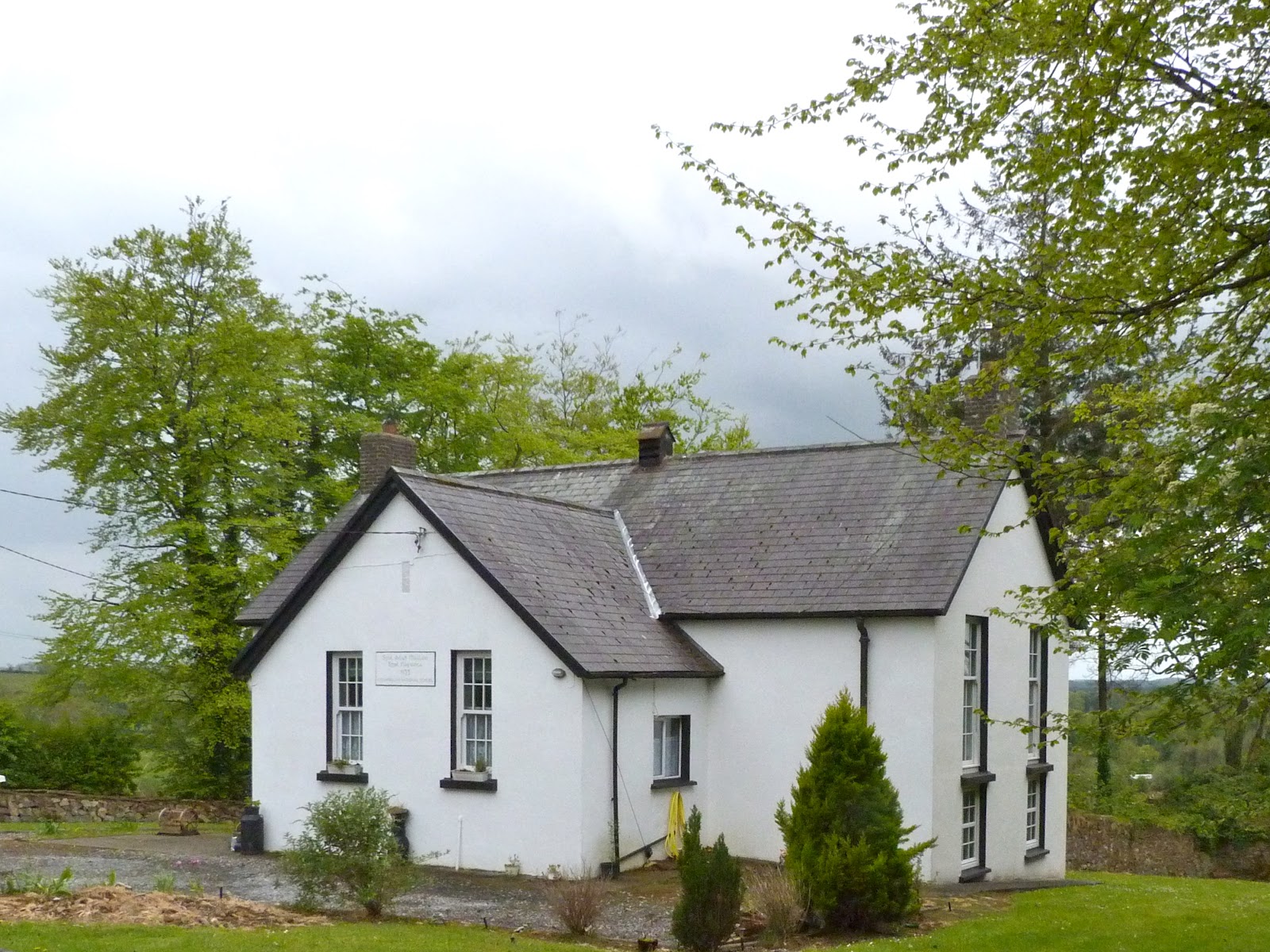
Aghawillian School
The first stop on a drive into Counties Roscommon and Leitrim in pursuit of John McGahern was at Cootehall, where lived McGahern’s father, an  ex-IRA senior officer rewarded, post civil-war, with the position of senior police officer at a quiet and peaceful country village Garda Barracks (Police Station).  When young John was but ten years old his mother, with whom hitherto he and his siblings had been living on a nearby smallholding, died.  Thereafter the children were obliged to share their domineering father’s private quarters at the Barracks.  The two-storey late eighteenth century building, nestling beside the river Boyle was probably built originally to accommodate a British army guard.  Presently it is a private house.  While there I photographed the house and the lake behind it onto which the young John McGahern would row the Barracks’ boat to read in peace the books which were his escape from the tyranny of life at home.  On the road in front of the Barracks McGahern’s family have had erected a memorial to him. It bears words from the book:  “. . . . a white moon rested on the water, there was no wind, the stars in their places were clear and fixed.  Who would want change since change will come without wanting?  Who this night would not want to live?”
McGahern's grave in St Patrick's Churchyard
If his life at Cootehall barracks provided McGahern inspiration and material for his first novel, “The Barracks”,  Augawillan, where he spent his first happy years with his siblings and his mother, similarly influenced, “Amongst Women”.  So graphic are McGahern’s descriptions of walks up the hill from home to the village school at which his mother taught that, to be there, in the village, on the tree-lined hill outside the school (now also converted into a private house, the school having been moved to a new, larger, building lower down the hill.) invoked in me a strong sensation of déjà vu.  Before leaving Aughawillan I visited St Patrick’s Church to pay respect to McGahern at his grave, which he shares with his mother, and to give silent thanks for the immense pleasure he has posthumously given to me through his writing.

McGahern’s last novel, “To Face the Rising Sun”, follows the lives of a group of people who have in common  the lake which their homes either overlook or of which they are within a stone’s throw.  John McGahern eventually settled in a house on the shores of Laura Lough near Fenagh, County Leitrim.  The narrator of “To Face the Rising Sun” also moved from the city to live tranquilly on the shore of a lake.  Although the Loch is not identified in the book there is more than enough circumstantial evidence within the narrative to suggest that Lough Laura had considerable influence on its geography.
Laura Lough near Fenagh