Flakes of the life of a sensate man; random notes and pictures that endeavour to capture capricious thoughts, largely of unreasonable and mysterious origin, before they leave forever the wandering mind of a life pilgrim stumbling towards the point where parallel lines meet. “Give me the sensate mind, that knows The vast extent of human woes!” M. Robinson Angelina II. 1796
Tuesday, May 22, 2012
Somewhere in the far distance is America
Standing high on these cliffs looking down on the calm sea on a benign spring afternoon it is difficult to imagine what might have been in the minds of the monks who, in 475 a.d., set sail in small boats from Teelin, the small harbour village below me, for the unknown. They eventually landed at Iceland, as far as is known to history, its first settlers.
An installation at the harbour records the event in Irish, English and Icelandic.
Friday, May 18, 2012
In pursuit of John McGahern
| The Barracks, Cootehall |
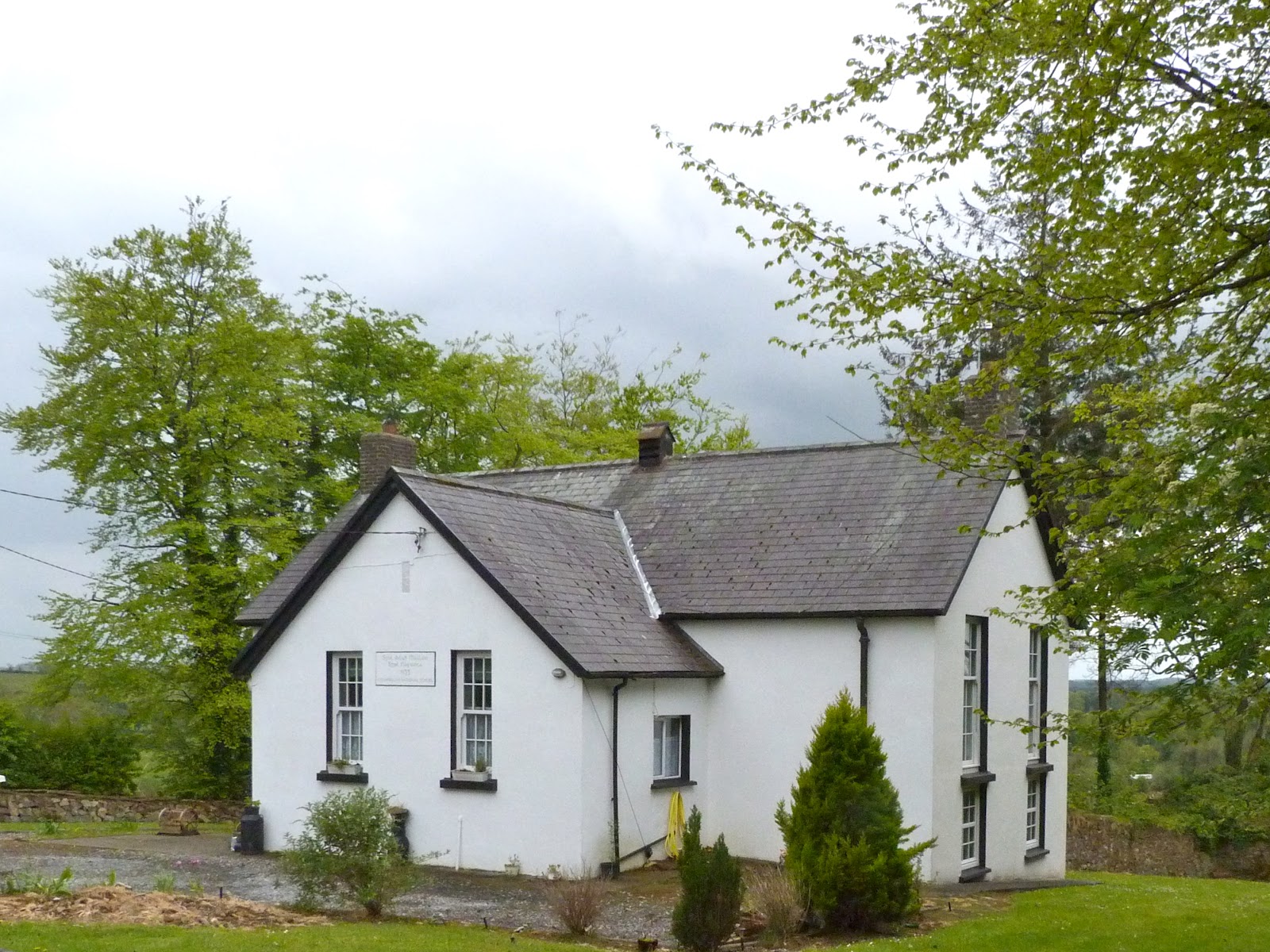
| Aghawillian School |
The first stop on a drive into Counties Roscommon and Leitrim in pursuit of John McGahern was at Cootehall, where lived McGahern’s father, an ex-IRA senior officer rewarded, post civil-war, with the position of senior police officer at a quiet and peaceful country village Garda Barracks (Police Station). When young John was but ten years old his mother, with whom hitherto he and his siblings had been living on a nearby smallholding, died. Thereafter the children were obliged to share their domineering father’s private quarters at the Barracks. The two-storey late eighteenth century building, nestling beside the river Boyle was probably built originally to accommodate a British army guard. Presently it is a private house. While there I photographed the house and the lake behind it onto which the young John McGahern would row the Barracks’ boat to read in peace the books which were his escape from the tyranny of life at home. On the road in front of the Barracks McGahern’s family have had erected a memorial to him. It bears words from the book: “. . . . a white moon rested on the water, there was no wind, the stars in their places were clear and fixed. Who would want change since change will come without wanting? Who this night would not want to live?”
| McGahern's grave in St Patrick's Churchyard |
If his life at Cootehall barracks provided McGahern inspiration and material for his first novel, “The Barracks”, Augawillan, where he spent his first happy years with his siblings and his mother, similarly influenced, “Amongst Women”. So graphic are McGahern’s descriptions of walks up the hill from home to the village school at which his mother taught that, to be there, in the village, on the tree-lined hill outside the school (now also converted into a private house, the school having been moved to a new, larger, building lower down the hill.) invoked in me a strong sensation of déjà vu. Before leaving Aughawillan I visited St Patrick’s Church to pay respect to McGahern at his grave, which he shares with his mother, and to give silent thanks for the immense pleasure he has posthumously given to me through his writing.
McGahern’s last novel, “To Face the Rising Sun”, follows the lives of a group of people who have in common the lake which their homes either overlook or of which they are within a stone’s throw. John McGahern eventually settled in a house on the shores of Laura Lough near Fenagh, County Leitrim. The narrator of “To Face the Rising Sun” also moved from the city to live tranquilly on the shore of a lake. Although the Loch is not identified in the book there is more than enough circumstantial evidence within the narrative to suggest that Lough Laura had considerable influence on its geography.
| Laura Lough near Fenagh |
Wednesday, May 16, 2012
A Search for Oscar
Yesterday drove to Cong, best known as the location of the Hollywood (John Wayne) version of Maurice Walsh’s short story, “The Quiet Man” but, of far more interest to me, the surroundings of Cong are also the location of two homes of Oscar Wilde’s ancestry. First I went in search of the ruins of Ballymagibbon House, eighteenth century home of Wilde’s Flynn ancestors. The site of the ruin is far and hidden from a narrow lane by impenetrable woodland edged by bog so I abandoned the chase and drove on in search of a compensatory lunch. Along the way I unexpectedly sighted, on a distant ridge, the second of my quarries; ‘Moytura’ the house Wilde’s father had built as a bolt hole from Dublin and in which Oscar spent many of his childhood holidays. (Often spending time, apparently, with George Moore and his siblings.)
Moore House
Moore House, was the ancestral home and birthplace of the Irish artist and writer George Moore (b.1852 - d1933). These days Moore is most remembered for his 1894 novel, ‘Esther Waters’, a critical social commentary of the horrendous plight of abandoned single mothers in his day. Moore had originally intended for himself a career as an artist and went to Paris to further that ambition. There he met Pissarro, Degas, Renoir, Monet, Daudet, Mallarmé, Turgenev and, above all, Zola, under whose influence Moore dropped painting for writing.
The ruined, burned out shell of Moore House is presently hidden within a forestry company’s plantation. Even in its poignantly sad decrepitude there is enough left of the building, today the protected home of a colony of Horseshoe Bats, to easily imagine how grand it might have been in its heyday but Moore House is but one of Ireland’s abundance of these sad ruins. The building was destroyed by fire in 1922, towards the end of the civil war, by the IRA who believed Moore’s brother to be a pro-treatyist. Ironically, it was the IRA who, in 1964, had a memorial plaque raised beside the road opposite the ruins of Moore Hall lauding the family for their famine relief work and for their ‘refusal to barter their principles for English gold’!
| Irish wit on a notice on the wall of the ruin. |
Wednesday, May 9, 2012
The Burren
| Spring Gentian |
| Megalithic wedge tomb |
At a first glance, the Burren, a hundred square miles of grey, rocky karst, appears to be no more than a desert of limestone pavement. Once on the pavement this initial impression is soon belied. The Burren is populous with an amazing variety of wild flowers. On closer inspection the apparently uniform, grey landscape is seen to be liberally splattered with patches of soil supporting thick blankets of grasses, mosses, lichens and wildflowers which in turn provide fodder for herds of grazing sheep and cattle. Over half of Ireland’s native flora grow in the Burren, none of them exclusively but often in greater abundance than elsewhere. What is fascinating is that here, at sea level, exist extensive colonies of the alpine Spring Gentian and Mountain Avens growing happily among orchids more generally found in the Mediterranean; where thick patches of peat cover the underlying limestone, lime-hating heathers thrive. This landscape has known the tread of mankind for a long, long time. Hereabouts are the remains innumerable pre-historic sites bearing evidence of human occupation together with the ruins of many early christian communities and places of worship. More recent ruins, those of peasant cottages some of which have only comparatively abandoned, also contribute to the history of the Burren written in the remains of mans attempts to provide himself with food and shelter. Time
| Abandoned peasant farm |
spent here also further belies an initial impression of the uniformity of the landscape. In Ireland the weather, and with it the light, changes with considerable fluidity. As it does so the appearance of the landscape, the contrasts of land to sky, the apparent colour of the rock, are all in a wonderfully constant state of flux.
| Early Purple Orchid |
Monday, May 7, 2012
Soliloquy on Solitude
Probably because I write my blog posts in the first person I have been more than once asked if I am travelling alone. For most of this trip I shall not be. Until we leave Ireland I shall be contentedly accompanied by Elisabeth, my companion for the past twenty years and more, thereafter she will make her customary trip north to Iceland while I return to Greece for the summer. I shall see her again in November. I justify my use of the first person when writing my posts by invoking my contention that practically all our lives, whether or not accompanied or amongst company, are passed alone. My posts are reports of my experience and mine alone; to use ‘we’ and ‘our’ rather than ‘I’ and ‘my’ would, I believe, distort the truth. How can I possibly know what sensations Elisabeth, or any other companion sharing an experience with me, is enjoying, or suffering, concerning that experience?
We enter the world alone and leave it similarly. Why then should we consider that through the time between those extremes we are anything other than alone. Perhaps during moments of extreme passion between humans there may be flashes of something approaching meetings of minds but these moments, even for the most passionate, add up to an insignificant percentage of an existence and are memorably transient as might be a particular aroma or taste.
Far from worrying in any way, my ideas concerning aloneness help me to treat time spent unaccompanied as being no different to time spent accompanied. By invoking a thesis that anything that can be rationalized can not be feared, these ideas foil, for me, the possibility of ever experiencing emotions of self-destructive loneliness.
Mona Best
| Bridge House B&B, Skibbereen |
![]() |
| Mona holding court in her lounge |
Mona Best, mine hostess of ‘The Bridge House’, a Bed & Breakfast establishment in Skibbereen, Ireland is an extraordinary character who has transformed a generally nondescript boarding house into what has been described in the ‘Irish Times’ as, ‘…...the most unusual B&B in Ireland’. In my experience it is the most extraordinary in all of Europe. Externally, the building although displaying signs of having been given more than a little thought, belies all of which lies within; a fantastic collection of objects to which Mona has, over many years, gathered in and now has displayed in most unlikely juxtapositions on every surface, both vertical and horizontal, throughout her home.
Everything in this museum of a place was, although occasionally shocking, a charming surprise. In my room I find, carefully arranged on the bed, a book, “Visitors from Hell”, or some such similar title. On top of the book an artificial snake has been coiled! A fully dressed mannequin stands guard over my door, another stands guard over a bath; beyond a half-landing window a huge imitation reptile snarls to be let in.
The breakfast table was a work of art. Particularly attractive was the turned wood butter tray; a curl of rich yellow butter topped with the complimentary coloured deep purple flower of a pansy.
Mona herself is a warm open soul who has known adversity in many forms but who adamantly refuses to allow the past to stand in the way of a full present. She is the kind of carelessly independent person that I feel better for, albeit briefly, having known.
![]() |
| Somewhere under here there was a bed! |
![]() |
| Room service? |
Subscribe to:
Posts (Atom)